Conscious Cash

Summer, Swifties and Spiders

One morning last week, I was up extra early and pouring water into my tea kettle in the kitchen. I looked up and on the other side of the window was a huge spider in action building their web.

As it was the wee hours of the morning, all was quiet. I paused while my water boiled and watched the beauty of the natural world. This process is mesmerizing. 

The intricacy of web was reflected in the ideal body of the spider designed for this task. The consistent pace of their movements. And the precision, yet simplicity that flowed with this process. 

I watched a good five minutes straight and then another ten minutes off and on as I made my tea - treasuring the moment intertwined with nature.

With such a close view, I saw the spider stop part way through the process. A pause? A rest? Some of both and the time change the silk coming from their body: Now was the time to add the sticky silk.  They were not hurried, as they made the switch from the strong silk building the frame to the thread designed for catching.

My only disappointment was that I did not see how they closed it off- that happened much quicker then I thought as they left a big opening in the middle. I did find a video which includes the making of a web for you and for me to watch the final step.  Beautiful Spider Web Build Time-lapse | BBC Earth

What does this have to do with your money? I find that the spider’s approach may lead to some examples to help us.  

At this time of what seems a whirling world, slowing down needs to be strategic. And it is necessary. Maybe all we can do is appreciate the basic, simple parts of life.  

Take one of nature’s tips:

1. Apply a consistent pattern to how you manage your money. 

What day do you pay bills? Attend to planning for the month? Are you consistent with saving each month? Do you use one credit card for subscriptions? Creating a system and sticking to it will make you happier and peaceful around the ups and downs of money life.

2. Can you simplify the web of your financial life by choosing one spending category and using cash for it. 

For example, use cash only for the month for groceries. The actual tangible dollar bills give you a sense of what you are spending and keep you connected to your money. Plus, there is no credit card bill to pay later or entry to confirm from your debit card.  

3. Plan a time for organizing your finances.

We are halfway through the year. Like a spider who pauses to take in their handiwork part way through, you too must take the time to connect with this important facet of your life. Rather than wait until the year end, what can you do today to review and smooth out your money life as you move into the second half of the year. 

4. Set time aside to review your credit cards. 

Many people look at their credit card bill when they pay it. However, the details may help you make changes. Or at least become more aware of your spending. The monthly subscriptions may all be things you use. Or the charges may simply be for services you use once and do not need now. Take a look and the time to cancel subscriptions you no longer use.

5. Create an annual review of your asset allocation of all your investments. 

As we get older, therefore closer to retirement and living off our retirement investments, we want to be more conservative with our investments. Our safety account and maintaining cash is still important part of our plan. We need to look at them separately. Like the spider with two different types of silk. You have two different pools of money for different purposes. Investments are not designed for the expenses you face in the next year. You need cash for that reason.

6. Get into the details that often go overlooked:

  • Obtain different bids for your home and car insurance. One thing for sure, insurance premiums are increasing but competitors have different plans and varying costs. You may save money but take the time to see what the premium costs are from another provider.

  • Understand your employer plans. Knowing how much you can contribute to your retirement plan and being reminded of your other benefits helps you take the maximum available to you.

  • Look at your health insurance. When you know the deductible your plan has, be prepared rather than be surprised with a medical bill. Put that amount in cash to have available if and when needed.

These are six tasks that make a strong and lasting financial home. You do not have to do them all at once. Consider taking on one each month until the end of the year. Like the spider’s intent determination to build a web to catch their food, you need to pay attention to the details to create a sustainable financial future for your life.

Weaving nature and your finances creates MoneyPeace.
Don't Be Caught Off Guard, Financially or Otherwise. I Was!

Don't Be Caught Off Guard, Financially or Otherwise. I Was!

True Confessions

In my desire to inform you of the multitude of ways you may be solicited criminally, I am sharing some current scams that have come across my computer screen. Yes, like you, I have been approached before by fraudulent operators. Here is how:

Motor Vehicle Violations:

Typically send to a cell phone number and occasionally an email address. I knew I had not been stopped recently for speeding. And I know my cell phone number is not used as my number with the Vermont DMV, so I felt smug in deleting it and seeing through the scam.

Other scam texts are for toll infringement or reupping your toll transformer, like EZ Pass. They always provide a link for ease of taking your money. Do not do it. Wait for the snail mail that probably will never come.

Social Security or Fraud:

Attention CHRISTINE MORIARTY,

This notice is to inform you that your Social Security benefits have been suspended.

To resolve this matter and restore your status, please contact the SSA using one of the phone numbers listed in the attached PDF.

Sincerely,

SSA Support Team

Social Security Administration

They have my personal email address and home address so one may find this convincing. However, the email address is bogus. Definitely not a Social Security Administration email address.

Had I been in doubt, I would have called a verified phone number from the Social Security website, SSA.gov. If Social Security was my only source of income, I may have panicked and clicked quickly.

Random Mindless Email and Social Media Scrolling Is Dangerous:

Late night scanning email and social media used to be an effective way to disconnect from reality and recover after a long day. No more. You are relaxed, perhaps move quickly and are too tired to recognize the delinquent email. My local email provider sent me an email on the Saturday afternoon of a long weekend last year. They are always responsive and proactive which is why I stick with them. On first glance, this seemed reasonable. The email requested I change my password as they believed that my information had been compromised. A few clicks and keystrokes later and I was done.

Then, I walked away from my phone to get ready for bed. But before I finished brushing my teeth, I was questioning myself. I went to check the return email. A fraud. I was caught. I checked the legitimate website in a panic. Called their 800# and seemed only to get “Call during working hours.”  Finally, I tried a third time and clicked through different options and got a live human. The lovely man helped me change my password and notified the company this email was going around.

The next workday morning I got a call from my internet provider asking if everything got settled. I thanked them. No such fraudulent emails from them since, but there have been others.

The First Google Number May Be A Fraud:

Whether you search Google, Safari or through another searching tool, you can find almost any number you want. The ease of finding the right number…unless it is not. The first number that pops up may not be legitimate. I know.

In the midst of a timely technology issue, I searched for my computer providers number. And dialed right away. I was under stress and needed help. They offered me help right away for annual service package which I paid for immediately. They helped me. And only later did I realize that the company had nothing to do with the legitimate maker of my computer. An expensive lesson.

The other big phone search scam area is travel. Stranded? Or under travel stress? That is just when the first number may provide answers and cost money. But may not be the legitimate company you are trying to reach. This has not happened to me but I have heard it from others.

The Famous Authors That Weren’t:

My writing gene is strong and I love to create. I dream of having a book published by a large publishing company. I take writing workshops, participate in two writing groups, and create connections in the writing world.

In February, I did not find it strange that a well-known writer had written to me as we had met twice. Surprising? Yes. Crazy? No. He promised to send me a gift to mark his milestone birthday. And then began an email correspondence, offering to help with publication. He wanted to share my work with his literary agent. I was pumped and we kept in touch for a few months.

Then, three weeks ago I got contacted by another author who wanted to lead a financial workshop with me. Hmm, I thought. I do not know this gentleman at all. I had participated in a virtual workshop and sent an email but never met him. However, I knew a professional friend who always worked with him. When I shared it with her, she thought it was legitimate, though probably written by his marketing team.

After an email or two back and forth, he mentioned Visa gift cards and Xbox cards. I knew it was a scam and forwarded it to my friend. I wanted her to tell the author and his team directly.

Meanwhile, back to the first author. He was sharing some personal information I could not verify online. He sent an edited piece of mine that seemed to have a flavor of AI. I never got his promised “birthday gift.” The pieces clicked in place. To finalize what I already knew, I asked for his snail mail address and video call. That response ended my belief. But three months of writing emails to an Artificial Intelligence (AI) bot feels a bit foolish.


The upside of this author fiasco? I have two polished book proposals going out to agents. I figure I got motivated to fine tune what I already had.

Yes, there are other companies that make disconnecting your information from them difficult. When you want to cancel a subscription where they have your credit card information, there are so many hoops to jump in and around. I do not like those at all. But the company themselves are not a true scam. Their product may even be good. They are trying to save their income to the detriment of time, energy, and focus.

Today’s world is full of frauds, financial and otherwise. The danger does lie in phone calls but increasingly with the internet. Artificial intelligence is fueling the scamming options and makes them very convincing. There is a lot on the internet about you. With AI being used for good and bad purposes, you need to stay on your toes.

Here is my new motto: Read carefully, access when awake and thinking clearly, when in doubt ask someone, and most of all, be cautious. Verify. Verify. Verify.

Take care of yourself out there. Money and personal risks come in all forms.

And if you are like me, you have also gotten caught off guard. Please feel free to share, with me and with others. The more we all talk about what is going on out there, the better prepared we will all be.

Finding Your Financial Way: First Bank Account

First Communion. Memories of this event are powerful for any young Irish Catholic child. First Communion was a BIG deal. The nuns at school prepared us for months. And the excitement across the classroom was evident. The planning at home was exciting.

For me, the white dress meant very little as it was a hand-me-down that barely fit and under other circumstances would have been deemed too short. Only the head piece of pearls caught my attention. This gem ridden adornment was part of my Mom’s wedding garb, and the shine caught even this tomboy’s interest.

My memory of this day is vague and rests in photographs. However, after the day is what I remember. That I could count so high! My pile of First Communion cards landed with two dollars here, a fiver there, or a ten-dollar bill on rare occasion. I knew the money would sit until my thank you notes were in the mail. My Mom insisted on hand written thank you cards.

On Sunday, the day after my big day, I was young enough to report to my Dad how much money I had! What I thought I was going to do with $80 is beyond me. That kind of money in 1968 was a fortune to a child. My piggy bank may not have even been able to hold it. I do know I had stars in my eyes, understanding I was holding more money than ever in my life.

Dad said one simple thing to me that changed my life.….

“I will give you twenty dollars to make it a hundred if you put it in the bank.”

I was quick to accept the offer. And pretty speedy to write those thank yous. My first financial deal was sealed.

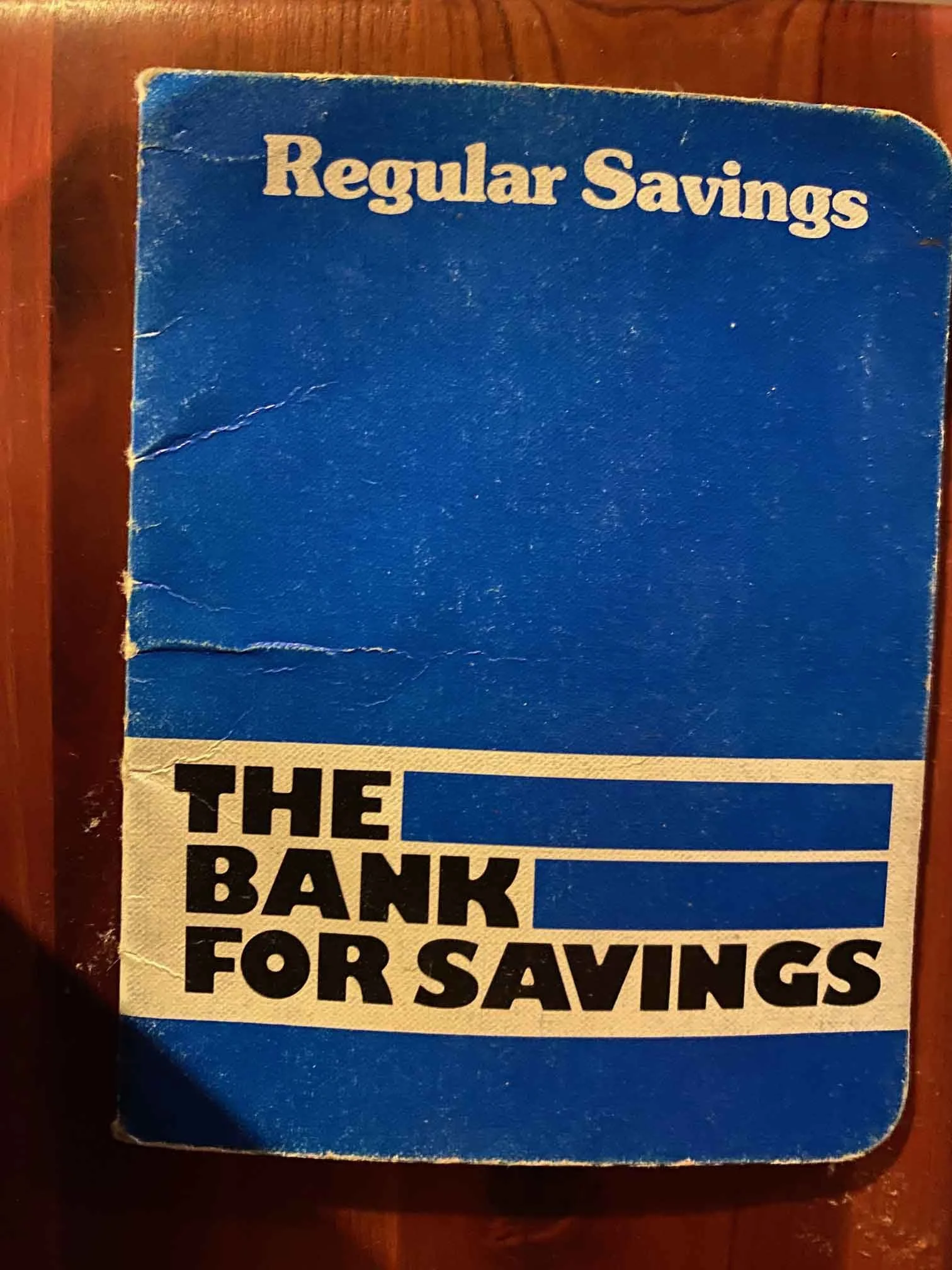
bank book

I saved my last bank book.

First Communion photo unavailable

Dad was not the one to take me to the bank. Probably my Mom or older sister walked me to the end of our street and across Main Street to the local branch office. I had been to this small bank before accompanying family – all who were older than me. Various family friends worked there over the years, so it was not an intimidating place.

That $80 would be worth $765 today – no wonder I had no plans for buying something. That is way more than I can imagine. And the $100 that opened my bank account? That would be worth close to a thousand dollars! https://www.usinflationcalculator.com/

Today, my original account is closed, though I can still rattle off the number. The bank is gone, merged with a bigger bank. I have the bank book with a box of mementos.

My Dad made a sound investment on that Sunday in 1968. He passed away eighteen years ago. Yet, that memory and the lesson ingrained in me has lasted a lifetime. Savings is good. Thinking ahead is great. And even a seven-year-old can have grown up things like a bank account. I also learned round numbers are fun to aspire to. Plus, watching it grow with my babysitting money, and interest taught me the power of compounding.

Having a savings account? That lesson is timeless and priceless.

Five Steps to Join Me in A Conscious August

Five Steps to Join Me in A Conscious August

Consciousness is what I teach whether with spending, saving or investing. What did No Buy July do for me? Reminded me to revisit and reflect on my spending periodically myself.

July was an opportunity to be more intentional about my spending or lack of it. Yes, by nature and profession I pay attention to numbers, especially cash flow. Yet, there is always room for improvement.

I often spend when I am tired – too tired to cook or exhausted from the day and just want to zone out in front of the television, meaning I reach for something that will entertain me best – often a movie or recently released series. Most of them with an upcharge.

I am a realist. In today’s world, spending is ever present. How you do it and when and why are the questions. Those deeper questions are what is important to getting one’s spending under control.

In addition, taking care of the financial details provides the clarity to get a handle on one’s finances. The month of July allowed me the time to slow down and really look at what was occurring with my spending.

You may benefit from my learnings. Here’s the specifics of what I learned and my next steps:

1. Write Wants Down:

I need to write things down that I want or perceive as needing. Delaying spending is a strategy we all can do. Then, you can prioritize and be thoughtful about your purchases. Plus, that mindful step which slows down the purchase, makes one more appreciative when the purchase arrives.  

Prioritizing is not easy, where I struggled was everyday typical things I used.

For example, are vitamins a want or need? I waited to replace some until the end of the month, considering them groceries.

And what if something broke, did I buy a new one right away? My electric kettle boiled its final water mid-month. As something I used multiple times a day, I wanted another one; however, I realized I had other options. I boiled water each day on the stove. The delay reminded me to appreciate an electric kettle. The wonderful convenience was the first thing I bought on August 1st. 

2. Review Subscriptions:

Taking the time to go online or on the phone to change or cancel subscriptions pays off. With the extra time last month, I revisited all my subscriptions. The prices have risen for many. Cancelling was easy for the ones I do not use often enough. Yet, each time I tried to cancel, I was offered a better deal. I came out saving about $12-15 dollars per subscription I decided to keep. And saving the monthly payout on the ones I cancelled.

3. Question Financial Apps:

People always tell me that their bank, phone app or financial procedure is the best way to go. Digitally makes everything easier. They do not mean you do not have to pay attention though. This month I learned, Venmo is not always perfect. I use it occasionally to pay or receive money from friends. When I went to pay for a yoga class, I noticed a request that was waiting out there from an event three years ago. Strange I thought I had never noticed before now and thought she had paid me. I did nothing until my friend texted me because she got the same on her end and was appalled she had not paid me. I told her I really thought she had but after looking through my Venmo app could not find the payment. She did some research and sure enough had a screenshot of having paid the exact amount the same month we travelled together. Lesson learned for both of us and now hopefully, you.

4. Make Minor Changes:

Minor changes add up to big ones. Not going into stores. Not using credit cards. And then avoiding the pervasive latte option. Slight changes make life better as there is more money left at the end of the month.

5. Benefits of Not Buying:

Not buying means Time for other things. If you are not scrolling Amazon, or clothing sites, nor heading out to shop, there is more time for walking, cooking, and being with loved ones. A bonus that far outweighs any other advantage of being conscious financially: time.

Always think critically about buying, signing up for a subscription or spending money. Spending needs to resonate with who we are, not be an automatic reaction.

So what am I doing for Conscious August:

1. Taking the time to write it all down. Whether I use credit cards, debit cards or cash, whether it is for business or personal, this month I will record it everything.  

2. I am also reading and sharing what others say about this money behavior we use automatically. Like Michelle Singletary who summed it up best in a recent article, “Five Financial Lies People Should Stop Telling Themselves.” 

Singletary covered a range of topics from not having an emergency fund to spending more on dining out than you really know.

Here is my favorite from her piece: 

"I manage my spending better with a credit card. Monthly statements show where money went, but research reveals that paying with plastic — credit or debit — increases how much people spend. A Federal Reserve Bank of Boston report found that consumers spend an average of $22 per transaction when paying with cash, compared with $112 when using cards."

To see the whole piece may be challenging as I am not a subscriber so sometimes I get in, sometimes I do not. Keep trying. Here is the link 

One outcome of my changing behavior in July? Watching the Seventies television show, Rhoda free on YouTube instead of the pricier Gilded Age. Spoiler alert, I am still sad that Rhoda and Joe separated. I think I am less attached to the Gilded Age characters as I did not grow up with them. That show feels like history. Rhoda feels like a friend. 

May you find more time for yourself and with friends this month and in the future, because of your conscious financial decisions. 

I will be out of the office periodically over the coming months for fun and speaking. From conferences to a friend’s wedding to speaking gigs. I am looking forward to an active fall.

No Buy July comes to MoneyPeace

No Buy July caught my eye because of the catchy rhyming phrase. I also thought “this will be a cinch.” Afterall, I'm already aware of my spending, I don't like to shop. And it's summer! My confident thoughts were misinformed. Confidence and consciousness do not always align.

Instead, No Buy July has had a deep impact on me. I have been learning even more about myself, my spending, and my choices. MoneyPeace’s principal of making conscious choices are not always aligned with my spending. Let’s call my choices “a little fuzzy sometimes.” Yes, I was still making a few not so conscious choices. I had no idea how often I stopped for coffee or a treat when I had a busy day. Using this as a reward and rest when a few minutes sitting in the car or chatting with a friend would have done the same.

Then, there is the burnt out me – stretched on the couch, looking for some intriguing show to watch. When I stumble on just the right thing, Amazon often wants to give me an upcharge. What is a few extra dollars? That is what they have trained us to think. Whether a monthly Netflix subscription, free week of HBO or limited time subscription offer flashing across the screen, this weary decision maker will usually click. However, day one of No Buy July, I caught myself before I did. Yes, I wanted to see the latest season of the HBO series, The Gilded Age, but I kept on track. (Please do not tell me what has happened.)

So I did jump in with both feet to No Buy July, but had to adjust in week one. Quickly I learned that I had to adapt one of my strict rules of no extras. I wanted to honor my commitments that I had already made. Last week, I took a friend out for their birthday lunch – it was delicious and fun. No matter that their birthday was in early June! I had promised them a birthday lunch and so I paid for something that wasn't essential or groceries.

I have found the upside to all this no buy. This past weekend I did some chores with the materials at hand. They were the projects that had gotten delayed partly because I really wasn't psyched to do them. In the midst of polishing windows, polishing my leather Blundstone boots and a bit of deep cleaning in the kitchen, I did not think about spending money at all. When I was done, the added bonus came to me: no longer were chores staring me in the face and making me weary!

I also cooked and baked this weekend because I had time. Those activities had their own benefits. I was staying off the computer and its buying temptations and ate better, too. Win, win!

There have been a few non-wins. After that lunch last week, I wandered into Sweet Charity. This delightful secondhand store always draws me in. On that day, They had candles at an incredibly discounted price and I bought four to have at home. Only when I got home and went to put them away, did I realize my slip. No one's perfect!

Whatever your motivation to try No Buy July or any other financial change, remember you have control over your money and decision making. You may want to cut your spending, stop supporting large corporations, or just become more attentive to your everyday life.

Here are some tips to get you in the swing of not buying:

  1. Can you get your family on board? Or perhaps some friends to make it more fun?

  2. Clean up some paperwork that has been set aside. Bonus if it brings in money such as medical reimbursement or expense reports.

  3. Plan an outing that is totally free. See how much fun you can have, then plan another.

  4. If staying off the computer is not for you and on-line shopping is calling, email yourself the piece of clothing or sporting equipment you really want. Then, set up a folder titled shopping or No Buy July and file it there. In August, go ahead back there and review. You will have an easy reminder if what you wanted is still important to you.

Pay attention to what you learn. This is about getting off autopilot and back in conscious decision making around your money. The world moves fast. We need the reminder that we do not have to keep up the pace. Sometimes a pause may be the most nourishing gift to give yourself.

Want to follow more about what I have been learning? Check out my videos on social media or my blog.

Have a fun month!

Are You Cash Conscious?

Money is essential. What is often overlooked in the world of finance is money consciousness.

Money consciousness is primary in having sound money sense. Which leads to more cents of course! (I could not resist.)

A cornerstone of financial health is understanding money – where yours goes, how much money you make and what the basic rules are around money. With today’s focus on the digital economy, we lose focus on where our cash goes. There was an “old school” mentality that was born out of the depression where households put money into envelopes marking each spending category for the upcoming week or month. Touching the money and organizing it in this way gave individuals the value of cash consciousness. They had to understand where each dollar went.

Reverting to the ways of almost a century ago is unnecessary. But also bypassing the process by giving over your financial control to someone else is problematic. This sounds like the easy way, even the right way if you listen to the advertisements or some “experts.”

1. Are You Giving Your Power Away?

Being consciously aware of what is going on with our money can raise our vibration and increase our funds. Being unconscious has the opposite effect.

When you give your power to a program or an app, you are not necessarily aware of where your money is going in the moment; Rather, you are doing the math and looking at the result of your spending. The number detail may be important but most important is connecting with a deeper understanding of your financial picture and your reasons for spending.

The YouTube commercial I hate is about subscriptions. Rocket money app wants you to sign up and it will tell you how many monthly subscriptions you are paying for. Sure, it is quick and easy once you enter all your bank accounts and credit card numbers. Essentially, you share all your financial data with a large company to reveal your monthly subscriptions. (Can you say a “Security Breach” waiting to happen?)

The greater cost is giving away your consciousness. Without money consciousness, you are without a guidepost for your dreams and money.

2. Create a Long-term Self-Sustaining Plan

Want an easier, free way for long-term success? No big company was involved. Here are the steps:

1. Read your statements.

Sit down for an hour and review your bank and credit card statements. Identify your monthly expenses and subscriptions that you are paying for as separate categories. Some are necessary like utilities. Other are optional like music and streaming video.

2. Manage those subscriptions.

Set another hour aside. Take one subscription at a time. Ask yourself: Do you need it? Do you use it? Does it have an annual option? Then, pay annually. You may save some money. Best of all, you retain some control each time the subscription comes due, whether you chose to renew or not. The email or text message will be a reminder that you have the subscription and a trigger to ask yourself if you still want it and can afford it.

3. Choose one mode of payment for all your subscriptions.

By lumping your monthly subscriptions together onto one credit card or one checking account, you will always know what you are paying monthly or annually for subscriptions. The monthly payments will be clearly noted on that account’s statements. Step it up a level by dedicating a separate checking account and depositing the necessary funds for each month through a payroll automatically. (Most companies allow up to five different accounts to deposit to.)

Taking these steps commits you to real time accounting. You know how much you are spending on monthly subscriptions. Your spending on monthly subscriptions will be obvious at one glance at a statement. Only simple math is needed.

When you want another subscription, your newly designated subscription account is the lone one you will use for those payments. If it is an impulse subscription, you will know pretty quickly if you can afford it as your paycheck will have to be redistributed to fund this added monthly expense. Knowing you will have to take this extra step may even slow you down as commit with your click to another mindless monthly subscription. By creating this system, you will be in a better position to make decisions and handle your money consciously.

Money is meant to be saved, spent, and enjoyed. Without consciousness, none of those actions are truly peaceful; Nor a reliable source of your ability to make sound rational, well positioned financial choices.

Make 2024 the year you reposition yourself.

Be Cash Conscious.

What are Annuities?

Question: “I just got an inheritance and a financial person suggested I purchase an annuity with $90,000. We were going to expand our home. I do want to be smart and do something wise for the long term with the money. What is an annuity? Is it a good investment?”

Christine’s Answer:

Good for you for wanting to learn about money.  

First, the annuity answer. An annuity is an insurance contract. There are many types and forms from fixed annuities to variable annuities which have an investment component. They are backed up the insurance company that sells them. If this financial person only suggested an annuity, then they may only sell annuities. Annuity is a product with a large commission for the sellers typically. If an investment person does not offer you more options, they may not be working in your best interests. 

Expanding your home sounds like an option, but do you have a financial plan? Use that inheritance wisely by consulting an objective financial professional first. You can meet with them on an hourly basis and they can evaluate if you have a safety account, how to manage any debt you may have and plan for your future. They can also further explain annuities and other options to best serve you. To contact one that does not sell products reach out to the Garrett Planning Network.

Once you are more educated you can decide your next steps.  

How Can I Stop Spending Money?

How Can I Stop Spending Money?

My number one tip is to create a spending plan. Choose ahead of time how you will spend your monthly income or other incoming money. This is a better way to think about your money than a budget, which I find is a limiting mindset. 

Do not shop in person or online or social media binge when feeling emotionally upset. We spend more when we feel bad. We also are less discriminating and more apt to make impulsive purchases thinking they will improve our life. Survey: 48% Of Social Media Users Have Impulsively Purchased A Product Seen On Social Media | Bankrate

If you are shopping: 

When buying on-line, put what you want in the shopping cart, but do not buy it. Or in a store, ask them to hold it for you. Sleep on it. After 24 hours, if you still decide you need it or if it is a want, you can easily afford it, then go ahead, and buy it. If not add it to a shopping tab for future spending when you get that raise, bonus or financial gift.  

Unlink your credit and debit cards to your favorite spending sites. Yes, you can do this. But you may have to delete it from your laptop and phone too. One click is too easy for all of us. (Yes, me too.) 

Do not be seduced by the latest best product on YouTube, Instagram, or any social media. These are advertisements. Realize that the sellers are spending big money to tout their product. They are making their money back by selling something to you. Some of what they sell is image and an improved lifestyle. An improved life is an inside job and taking care of your finances is one way to make a better life for yourself. 

Cash Is A Treat, Don’t Let It Trick You

Money conjures up all sorts of preconceived notions for people. The subject can be emotionally loaded and money is one of the least talked about subjects in our society. Yet, money is simply how we barter and exchange our energy. In our fast moving society, we often move at such speed we make sloppy decisions.  

To make your life easier and be more attentive to your money, I offer seven tips, or “treats”, for you to not get tricked in the coming weeks and months:

1. Emotions should not rule. 

Money is tangible and important to our lives. With that in mind, we need to be sure our emotions are not distracting us from money. Attitudes about money influence behavior and can take the form of avoidance, impulse spending, over saving and more. Check in with your emotions but do not let them rule decisions. 

2. Use planning and understanding for your finances.

People tend to do the same thing they always do, including when it comes to money. If you do not review your spending or get quotes for services, even little amounts add up quickly. When you do, you may be surprised at what you spend. The Seemingly Small Money-Saving Habits That Add Up Over Time

3. Manage your money; Don’t let it manage you.

Study after study demonstrate that wealthy people are organized around their money. They have a plan for savings, investing and spending. Reevaluating their system helps them move forward in their financial life. The time invested up front to create the system pays back dividends over a lifetime. This includes how they manage money the “old-fashioned” way. Paper checks are dead. Cash is dying. Who still uses them? - The Washington Post 

Wealthier people and older people use the majority of paper checks. Are they wealthy because they are tracking their money more carefully? Consider trying it for yourself to find out. Autopay may not be the best answer to paying bills. Autopay Is Making Us Worse at Managing Credit-Card Bills - WSJ

4. Convenience is not always the financially smart approach.

Credit cards are great. Debit cards support our spending while not getting into debt. However, easy, may not be the best solution for all spending.  Discounts are often offered for those who pay cash because business have to pay fees on each and every transaction no matter how small. Want a Discount? Pay in Cash - WSJ These fees add up quickly especially for the Mom & Pop stores who operate on tight margins. Being a good customer may mean more than frequenting a store. Community minded may get you a discount and benefit small business owners. Carry a bit of cash on you. Why many business owners would love it if you stopped using your credit card - NPR

5. Saving for the long-term and short-term are different.

Your retirement accounts need to be considered as long-term money and not to offset bills, debts and inflation now. Instead, build up savings to have when financial distress comes your way. Keep your retirement accounts where they are to avoid extra income taxes, penalties, and a delayed retirement.

Americans are pulling money out of their 401(k) plans at an alarming rate - CNN

6. Create a plan, not a rationalization for your money and expenses. 

This seems like #1 but using your intellect to justify spending is not financial planning. The flaw is that a rationalization is not based on sound financial principles and your overall situation. Your thinking alone does not make a financial decision the sound money approach. If It’s Under $5 It’s Free: The Logic of ‘Girl Math’ and ‘Boy Math’ - WSJ

7. Experience rules. 

No matter our age or profession, personal experience is the greatest teacher. Be gentle with yourself when you make a mistake. That is part of life. Repeating it puts you in the danger zone financially.

I teach about consciousness around money. That will get you the furthest in life and wealth. Conscious behavior often means we must slow down, take our time when making decisions and align our priorities with our values. Then, we can make the best choices for us over the long-term and short-term.

Economic Concerns for Your Attention

Why am I concerned about the economy?  This country has a debt problem from government to individuals.  If we do not slow down and pay attention to how and where we spend money, the whole system could fall apart. 

As I always talk about financial self-care, I wanted to reiterate why it matters today. Financial change is happening everywhere, not just with the banks.  You can only control your part of the world but first learn what is happening and why that is more important than ever.

Here is what I am paying attention to with trepidation:

1.  Car loans are rampant with over 30% of people financing a car

People cannot afford transportation costs.  Given some may be buying more car than they can afford, but this is ridiculous to have so much debt out there for a depreciating asset. In addition, a greater number of people are defaulting on their car loans.

2. Credit card balances are high 

On average people have over $5,000 in credit card debt, worse, defaults are on the rise.

3. Savings are depleted

Remember all we were saving during lockdown?  Those accounts are dwindling.

4. Commercial office buildings mortgages delinquencies rise

With work from home movement and other changes, the rate is around 5% this year.

5. Traditional measures  

Employment looks strong, and inflation is stable by many reports; These positive measures are critical to a budding economy.  I believe they cannot stand alone without other financial factors which matter to each of us individually.

6. Rising interest rates  

The interest rate changes are affecting businesses and consumers on the loan side.  Sure, savers gain but see my list, # 3 above. 

7. Debt ceiling compromise was a temporary fix  

This issue will come to the forefront after the next election, or sooner.  Right now, the astronomical amount is easy to understand by calculating per US citizen is close to $7,100 each. 

8. War in Ukraine  

A country I am humbled to admit I couldn’t have found on the world map a decade ago is now in splinters and affecting global stability and peace.

Something is going to give.  Perhaps in the long run all will be well.  In the meantime, being prepared to ride out the fiscal downside is crucial.

I am not chicken little saying “The Sky is Falling” rather …

Instead, I’m encouraging living by the Girl Scout model of “Be Prepared.”

You have heard it before from me many times. This attitude is a product of my Girl Scout years and career. Stay financially sound with these five ways to be prepared for the unforeseen whether flooding, fires or economic downturns:

Five Steps to Maintain Your Prosperity Preparation:

1.     Create a safety savings.

2.     Live on less than you make.

3.     Check and cross check your insurance coverage.

4.     Be Prepared for downsides financially and with an estate plan.

5.     Enjoy the upside by living in the simple pleasures and appreciating what you have today.


Whatever you do, do not take money out of your long-term goal, like retirement, to fund your life now.  That will backfire in the long run, leaving you with less to live on in your older years.

Balance is key.

When you have the downside contingencies taken care of, you will be prepared for the worst.  Then, you truly will be comfortable appreciating and savoring the best.

Looking to read more about what the economy is doing? Here are some resources:

Travelling Close

Growing up, our house had regular visitors from overseas. My Irish relatives would typically descend in the summer and as a result, I would be on hand to be part of the entertainment. Truly, my parents were planning and executing the day trips. Typically my mother would take the actual trip and do the driving. As the youngest, I was along for each ride for many, many years. From Boston, Plymouth Rock was not far. Bunker Hill Monument and The Constitution were only a few miles away, as was the seashore. So before the age of twelve, I had climbed over “The Rock,” sat on the cannons and climbed the stairs of these historic monuments many times. In junior high, I was shocked at how few of my classmates had even been to one of these local sites I had frequented.

This summer, I decided on rather than one long vacation, a series of Fridays off would give me freedom for long weekends or day trips on a less crowded weekday. So far, this option has created many adventures and opportunities to see novel places and even act as a tourist in Vermont.

Let me be clear – this does not feel like the recent “stay vacation” movement of past years, where a week was spent at home. Or the overall goal was to save money. Rather, I have time for long weekends that are not too far away. Or daytrips where I can be the “visiting” tourist in my own backyard. None of this involves undue planning or plane flights which takes more energy. Long drives leave time for exploration and side roads. No matter that there seems to be construction everywhere in Vermont. None of these excursions are time sensitive.

The result? August is here and I have been to several unfamiliar places and had new experiences. In Vermont, I went to a couple of local festivals from Beer festival to Street festival to a few Vermont state parks. I visited places that had been long remodeled and well touted since I was there a decade ago. I acted like a tourist at the King Arthur Store and Simon Pierce outlet. And I was home in my bed that night. Relaxing and fun.

There was energy to head to the Eastern Townships of Canada – a whole new area I had never experienced. Lakes, scenery and a foreign country all rolled into one. There was a day of photography with friends, a day boating on the lake with a generous friend with a boat and an afternoon ferry ride across the lake to New York to cool off one afternoon.

One weekend, my husband and I went away to Ontario. We had the pleasure of staying with friends a night who introduced us to their main local summer event – The Scottish Highland Games. The music was fabulous! (Thanks Louise and Jamie!) Then, we headed to the city of Ottawa for a night. We caught a street festival of performers and an amazing light show on the Parliament Building. Each night we had fireworks too. A bonus: These unique city events were all free! We came home refreshed after a total change of scenery for a weekend.

Attitude is what has made these days fabulous. And of course, the weather has helped. But the perspective of doing something different and having a day or two of open time meant each trip was rejuvenating.

We all get so caught up in doing activities that we have enjoyed for years that even vacations happen on autopilot. A bit of variety from our way of doing things may just be the ticket we want and need to finish off this summer and move into the cooler months of the fall.

I suggest you try an experience that is different this month. Worried about the cost? Remember the event does not have to be expensive. Festivals are often free. Renting a kayak or bicycle for an hour or two costs less than a dinner out.

And best of all, according to research, experiences mean more to us than buying things. So skip the new purse and take yourself and the crew on a beach day!

No time for more, as we are off to the Addison County Fair!

Enjoy Summer!

Making the Grade on Your Financial Life

Congratulations you are on your way to graduating!

Senior Spring- Finishing up Final Exams. Writing your final paper. Planning graduation and the parties… An exciting time filled with fun and promise.

You may be pondering what is next? First, I have the perfect, albeit practical graduation gift for you. My gift to you is some pointers for getting you off on the right foot financially. Like your study habits that got you through college – better to start with good money habits with your first paycheck.

Fun Fact: Did you know that John Rockefeller started giving to charity with his first paycheck?

You can set up a system to last a lifetime. Apply your willingness to learn and try new experiences with the information below.

Listen, I know that in college you bought Ramen noodles by the case load and traveled in packs to places that offered discounts. You are excited about the option of fine dining and doing some traveling. However, do not lose sight of those thrifty skills you acquired in college. More than one recent graduate has been led astray thinking they were making the big bucks and forgetting about the financial basics before making that financial splurge. Start with a monthly overview of what you need to spend and where, rather than just collect a paycheck and spending without thinking.

First, think of your financial life in three parts: present, past, and future. All are important components of your new life. Each has several pieces that need to be addressed to adequately address your financial life.

Think Present

Safety Account

While in college, money came in and went out. All that you really needed was a checking account. You may have had a savings account attached to your checking account where you stored money you did not need immediately. Now, you also want a safety savings account for building a cash reserve. This account will grow slowly as you make contributions regularly either through direct deposit of your paycheck or a deposit in person or on-line. Think of this account as the money you fall back on when the unexpected happens and you need cash to maintain your life: a car accident or loss of job.

Not having enough cash to go out with the gang on Friday night is not cause for touching a safety account.

  • Have a local checking and attached savings account.

  • Open and fund a second savings account without ATM access for emergencies.

Renter’s Insurance

You get home after a long day at work; your laptop is not where you put it. For that matter, your new digital camera is gone. You call the police. Will you ever get your electronics back? Questionable. Who will pay for your new ones? You, unless you have renter’s insurance.

Renter’s insurance pays for your possessions if they are stolen or destroyed by fire. The policy costs just over a hundred dollars a year. You have a flash drive and a portable hard drive; they are one type of insurance, why would you not have renter’s insurance?

If you rent an apartment:

  • Purchase renter’s insurance – available through your local insurance agent who sells car insurance. Or ask your landlord the insurance professional they recommend.

  • After you pay a deductible of $250, the insurance company will reimburse you for anything stolen or damaged due to theft or fire above that amount.

  • The policy is available for pennies a day. Get it!

Health Insurance

You finish college and it is time to explore health insurance. Many young adults have coverage until they turn 26, others do not. If you are not covered by their health insurance. What do you do?

  • Learn the lingo about on the health insurance front: deductibles, pre-exsisting conditions, and premiums.

  • Consider a job with health benefits.

  • Check out your state’s health plan. Many states have coverage for the under or unemployed at discounted rates.

  • Consider Catastrophe Medical Insurance for in-between coverage:

    • Designed to cover a major accident or illness.

    • Temporary –usually up to three years of coverage available

    • Policies are inexpensive- often as low as $60 a month.

    • Deductibles are high- $25,000.

    • Minimum health insurance you need while in transition.

Think Past

Student Loans

Unless you are walking off the stage and accepting a huge signing bonus that covers your student loans, then you need to start looking at what you will be paying, what you owe, and how to make it happen. If you have no student loans, you can read on to the next section.

Your federal student loan payments may not require monthly payments until six months after graduation. If you are employed, do not wait six months to start looking at that bill. Start right away by writing a check for that amount. For the first six months, put the check in your safety account. This will help build up the safety account. Most importantly, you will not rise to a level of spending and lifestyle only to have to change it six months down the road.

Make the list of important student loan information and keep your debt information organized.


Other Loans

Line up all your paperwork on your loans. If some are in your parents’ name and you are required to pay, get that information too. Write a list of each loan, the full amount you owe, the interest rate, monthly payment and the term or time you will be paying. Having this on one page or one spreadsheet will help guide you to an understanding of your financial responsibilities. (See above)

If you are traveling, planning on graduate school or still unclear on your plans, talk to the loan company, or find out the details on the web to determine if you can defer payments, how to do it, and how long it can last. Federal loans tend to allow you to defer. Private loans often do not, so you may need to find a temporary job right away to pay the monthly loan.

Credit Cards

Be careful - there is only one entity that is getting a deal on these cards. That is the credit card company. Used wisely, these are a nice tool to have. However, no one needs more than two credit cards. And consider in our society of immediate gratification, credit cards are overused and often lead to abuse.

Get credit savvy:

  • Know what interest rate you are paying on your credit cards. You can find this in your statement.

  • Protect yourself by writing a check immediately after using the card. Taking the money out of your checkbook creates no surprises when the bill comes.

  • If you are already swimming in credit card debt, stop using your card. Use the steps from the student loan section above to lay out what you owe and when.

  • Create a plan to pay off the credit card debt you now have.

Credit Score

On a college campus, you often cannot get away with anything. There are always people around. Professors know each other and you have more dorm mates than close friends. You know news travels fast. Your credit score works the same way, someone is always watching.

Good financial actions get reported to credit reporting agencies:

  • Timely payments of student loans, credit card debt and car loans

  • Your credit history for all loans paid in the past are recorded.

Financial actions get reported and negatively affect your credit score:

  • Not paying the overdraft fees on your checking account

  • Late payments to your credit card, student loans or car loans

Financial mismanagement can work against you and gets documented on your credit report. Keep your credit score solid by being attentive to your financial life. A credit score will affect your ability to buy a house, get capital to start a business and even some offers of employment. Often, landlords use credit reports when considering you as a tenant.

You need never pay for your credit information. Your credit score is based on your credit reports. So, you need only look at your credit reports – I recommend annually. They are free for you to see and confirm they are correct. Learn more at: www.annualcreditreport.com.

Think Future:

Job Choice

Deciding on a job is a critical time. Do not forget to ask what employee benefits are provided as part of the job. The better benefit package a company offers may not make their salary look competitive. When comparing opportunities, review all aspects of what the company is offering you.

Then when you start, sign up for the benefits and take advantage of them. The benefits an employer may offer you include:

  • Health Insurance

  • Disability Insurance

  • Life Insurance

  • Retirement Investment Options

Disability Insurance

This pays you if you are off the job due to injury or illness. Some companies provide it as part of their benefit package. Some require you to pay a minimum each month to get coverage. This insurance pays you a part of your monthly salary if you are out of work due to disability.

Although this type of insurance does not seem to fit a healthy twenty-year-old, the majority of disability claims are from 25–36-year-olds. Think last time you were mountain biking, skiing through the trees, or diving. If those close calls had happened, then being out of work would cost you in more ways than one. Younger people tend to be more active, so need disability insurance too.

Life Insurance

This insurance pays an amount to someone you designate upon your death. Think about who you would benefit most from this added cash. Your best friend may come to mind. However, review your student loans. Federal student loan requirements typically stop at your death. If your parents co-signed any of them, they will be responsible for paying for the loans even after you die. Choose your beneficiary wisely.

Retirement Plan

Start funding your retirement right away. Even though you are young, this one good habit can pay off for a lifetime.

  • Saves income taxes.

  • Builds investments for your future.

  • Provides hands-on learning about investments.

  • Some companies provide a match in dollars if you contribute.

Roommates

One young client of mine could not afford a studio in Boston and still pay student loans and have discretionary money. I discussed the possibilities of roommates so she could keep her financial commitments. Sharing expenses stretches your paycheck and makes financial sense. Instead, she took a second job on weekends so she could live alone. Remember:

  • You always have financial options.

  • Take the one that works for you.

On Graduation Day, enjoy knowing you are prepared to take on your financial world. The cash that makes its way into your graduation cards can be used in multiple ways to jump start your financial life. You can start your safety account, fund your apartment’s security deposit, or pay off some debt, along with having some extra fun.

You are moving into a new world filled with fun, challenges, and opportunities. This does not carry a grade. There will be no final exams or papers. The outcome does affect your life. The financial decisions you make as you enter the post college world can make your road easier in the years ahead or trip you up a bit. Keep these financial tips handy to get started and keep your financial stash growing.

Financial TLC

Financial TLC

February is the month we associate with love, caring and cuddling, because of Valentine’s Day. Yet, Love is always in fashion. Love of yourself, your partner, your family and your friends reign throughout the year. 

This month I want you to give yourself some Tender Loving Care. Whether you are coupled, single or searching, taking care of yourself is critical. I want to encourage Financial TLC. In the midst of the life, we often forget to take care of the details. True TLC is the key to a solid financial life.

What is financial TLC?

Transparency

Be honest about money: with yourself, with each other, and with loved ones. Write down and review where your financial life stands: income, debt, investments, bills. Looking at the list in black and white often gives you a reality check that no other system can. This is critical to share with yourself first and foremost. You need to know where you stand and what your commitments are.

Your partner needs to know as relationships are tied together. In marriage, you are bound legally. Even if you are not married you may have shared commitments like rent, pets, and family. Knowing about the other commitments your partner has makes assessing your situation a lot clearer.

Link the Details Together

Know what the accounts are and where to find them for each other. And be sure the bills are in both names.

If you are single, you may feel you are only responsible to yourself so there is nothing else for you to do. Your details will matter to your loved one if you were critically ill or die suddenly. They would have to pull the pieces together. So have a file with the details that they would have to know to handle your financial life. Tuck away the details. You do not have to share everything but let someone who loves you know where they are.

Conversation - Caring Conversation.  

There is embarrassment, there is past money flaws, there are emotions involved around money. We all have them. The secret is not to let them rule your life. The best way to do this is to share them in a way that works for you. This may be journaling, therapy or a good heart to heart with a friend. If you are part of a couple, talking to your partner is not optional, it is a necessity. Financial intimacy is as critical as any other part of your relationship. 

The bottom line is love relationships are impacted by money. TLC is investing some time in your money relationship. TLC and honesty with yourself and others will demonstrate love on many levels.


The Benefits of Simplifying

Simplify, Simplify, Simplify but Not too Much

Tis the gift to be simple, 'tis the gift to be free,
Tis the gift to come down where I ought to be;
And when we find ourselves in the place just right.
— Shaker Folk song by Joseph Brackett

Money is good for so many aspects of our lives. Yet, the management of our financial lives can distract us from happiness. When we are overwhelmed with statements, options and misinformation, we may make impulse decisions or ignore our money all together. Both can land us in more turmoil.

Focus, time, attention and energy are required to manage money whether you have very little or are gifted with large accounts. You need an overall strategy to prevent your constantly thinking of your financial concerns and the market.

Your cash and investments accounts tell a story; the story of you how you treat your money. Create a cash management plan that matches your expenses to income and demonstrates your self-care. No matter how much or how little money you have coming in, taking steps to gain clarity around your money is critical. Money is only as valuable as what we spend it on. We chose what to spend it on, but we first need to know what we have.

As with anything you organize, the initial set-up demands time and a plan to establish. After the system is in place, there is less time and energy involved to maintain it.

First, start with a cash management plan. 

This is a tool to understand where your money is being spent. This will also help you determine how many money accounts to actually have. There are three accounts everyone needs: a savings, checking and separate safety savings account. Beyond that, the more moving pieces in your life, the more bank accounts you will need.

A homeowner may want an account to save for real estate taxes, capital improvements and maintenance. A couple with young children may want a separate childcare account so they always have the cash to make a daycare payment. Keeping your funds separate this way prevents confusion and ensures the money is there when you need it. Plus, though at first glance more accounts sound complicated, there is less need for calculations as each financial need has a place.

Consolidate Some of Your Investments

As far as investments, diversity is a great approach to investing. However, if you have several investment advisors or retirement accounts from previous employers, you could be working against yourself. Variety does not lead to diversity. Rather, the complexity may lead to a lack of your comprehension of what you are investing in, what your options are and how many accounts you do have.

Create a better grasp on your investments by gathering up your investment statements and decide if you need to merge all your 40lks, 403bs and/or IRAs. Then, take the steps to make that happen. This month. Such an administrative step is easy to put off, so give yourself a deadline and envision the fewer emails and paper you will collect with fewer accounts. Most of all, with less to manage, you will be sure to have time to understand and choose your investments wisely in 2023.

If you have different investment advisors, understand what they do for you and how they work. Find out what they charge, specialize in and how they can help you even more. Do some research and perhaps merge these accounts as well. First, learn more about your Investment Advisor.

Finally, Take Time to Relax

After making progress, you will have more time. Spend time on your passion. Enjoy your family. Go for a walk in the woods. Or treat yourself to some music. Here is an instrumental version of Tis a Gift to Be Simple. (The words are provided if you choose to sing along.)